
An 8-person team. 5,800 invoices a month. A 14-day turnaround. Then they tried AI for the second time.
Executive summary
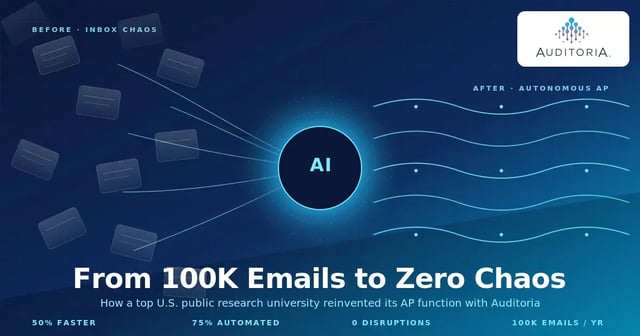
A top-tier U.S. public research university — running Workday Financial Management with an 8-person AP team — was drowning in roughly 100,000 vendor emails a year. Their first attempt at AI failed. Their second, with Auditoria, cut invoice turnaround in half, automated 75% of workload distribution, and absorbed a 25% staffing shortfall with zero service disruption. Here is what changed, and why it matters beyond higher ed.
The problem, at scale
Every month, the team processed more than 5,800 invoices on top of vendor inquiries that had to be reviewed and resolved by hand. About 90% of the 100,000 inbound emails per year were just invoice submissions. Peaks pushed past 10,000 emails in a single month.
At that volume, even small inefficiencies compounded. Invoice turnaround sat at 14 business days. The AP manager described being “in the trenches” with her team, with no bandwidth left for analysis, optimization, or anything resembling management.
Why the first AI project failed
The institution had tried to solve this before. A consulting firm built a custom AI invoice processor. It struggled with PO-to-invoice matching and never delivered. The project was shut down — and the team was understandably skeptical of every AI vendor pitch that followed.
A senior leader saw Auditoria at Workday Rising and was intrigued, but it took months of demos, reference calls, and due diligence before they moved forward. Her advice to peers maps directly to the lesson from that first failure: talk to existing customers, get hands-on with the product before you commit, and understand your own process well enough to ask the hard questions.
What changed after go-live
When Auditoria AP Helpdesk went live, the system processed more than 500 emails on day one — higher than anyone had estimated. The bigger surprise wasn’t speed. It was visibility. For the first time, the team could see exactly how much volume they were absorbing, broken down by type, by day, by month. Numbers that had previously been guessed at by counting files in folders were suddenly real-time data.
By the numbers — before vs. after Auditoria:
-
Invoice turnaround: 14 business days → 7 business days or less
-
Time per invoice: ~10 minutes → under 5 minutes
-
Workload routing: manual triage → ~75% automated
-
Email volume: 100K/year, constant backlog → 100K/year, no backlog
-
Service during a 25% staff shortfall: at risk → zero disruptions
“It was hard to keep staff morale up when you get through 100 invoices in a day, and the next morning the queue looks the same. Auditoria broke that cycle. My team is down two people right now, and we’re still keeping up.” — AP Manager
The role of AP, redefined
The job itself shifted. Instead of reacting to inbound email all day, the team moved upstream — managing exceptions, optimizing process, and supporting broader finance work. The AP manager finally had time to manage. And departments that had previously only noticed AP when something went wrong started seeing the function differently.
Three takeaways for finance leaders
1. AP is rarely a process problem alone — it’s a visibility problem. You cannot optimize what you cannot measure, and most AP shops are still measuring by intuition.
2. Removing repetitive work doesn’t shrink the team — it shifts it. Headcount need didn’t drop. Higher-leverage work, retention, and morale all improved.
3. The first AI win is the one that funds the next ten. This institution is now using AP as the proof point to expand AI across finance and HR.
“We’ve improved AP dramatically in the last two years, and Auditoria has been central to that. It’s the first AI solution in our finance area that I would actually brag about.”
— Executive Director
If you’ve been burned by an AI pilot before, the playbook here is worth borrowing: do real reference calls, run a constrained pilot on a process you understand deeply, and measure the visibility gains as carefully as the throughput gains.
Read the original case study here.