Two hundred and fifty years ago, the question wasn't whether to leave. Everyone who needed to answer that had already answered it. The question was what, specifically, needed to be named — and what the new system was going to look like when the transition was done. That document wasn't a complaint. It was a runbook.
The AP directors running Hyland OnBase or Brainware for five-plus years ask a similar question. Not "should we migrate?" They already know the answer. They ask: What does migration actually look like — and how do we get there without a month of invoice processing chaos?
This issue is the runbook.
The mistake that makes migration harder than it needs to be
The organizations that struggle with this transition treat it as a technology swap. They look for the functional equivalent of what Hyland does, map features one-to-one, and try to lift-and-shift the existing workflow into new software. Three months after cutover, they wonder why their exception rate hasn't moved.
Migration from template-based OCR to agentic AP is not a lift-and-shift. It is a workflow redesign.
The technical reason is architectural. Template-era capture systems absorb edge cases as code. Every new supplier quirk — an unusual layout, a non-standard field position, a format change — becomes a block of logic that has to be built, tested, deployed, and maintained. That logic accumulates. Over five or ten years, an enterprise AP deployment can carry dozens of supplier-specific code blocks, each one a maintenance commitment and a deployment risk. The exception rate doesn't go down because edge cases keep arriving faster than the templates can absorb them.
Agentic AP inverts this architecture. Customer behavior becomes configuration — editable, testable, and publishable by an AP manager without a code change or a redeployment window. The system identifies who sent an invoice before it begins reading it — loading vendor-specific context before the full extraction starts — so it already knows what to look for. New suppliers are onboarded without an IT ticket. Format changes are handled without a deployment.
"Every edge case absorbed as code is a maintenance commitment, a deployment risk, and a reason your exception rate doesn't go down."
The organizations that get migration right understand this distinction before they start. They don't look for a Hyland replacement. They define what their new operating model looks like — who reviews what, under what authority, with what escalation paths — and then select a technology that can execute that model. The operating model design is the migration. The technology switch is the implementation.
The context: why this conversation is happening now
Gartner's most recent Hype Cycle for Autonomous Accounting places intelligent applications in finance — AP and AR as the explicit starting point — on the Slope of Enlightenment, moving toward 20–50% market penetration. The migrations that define which organizations own the AP leg of their cash cycle are happening now.
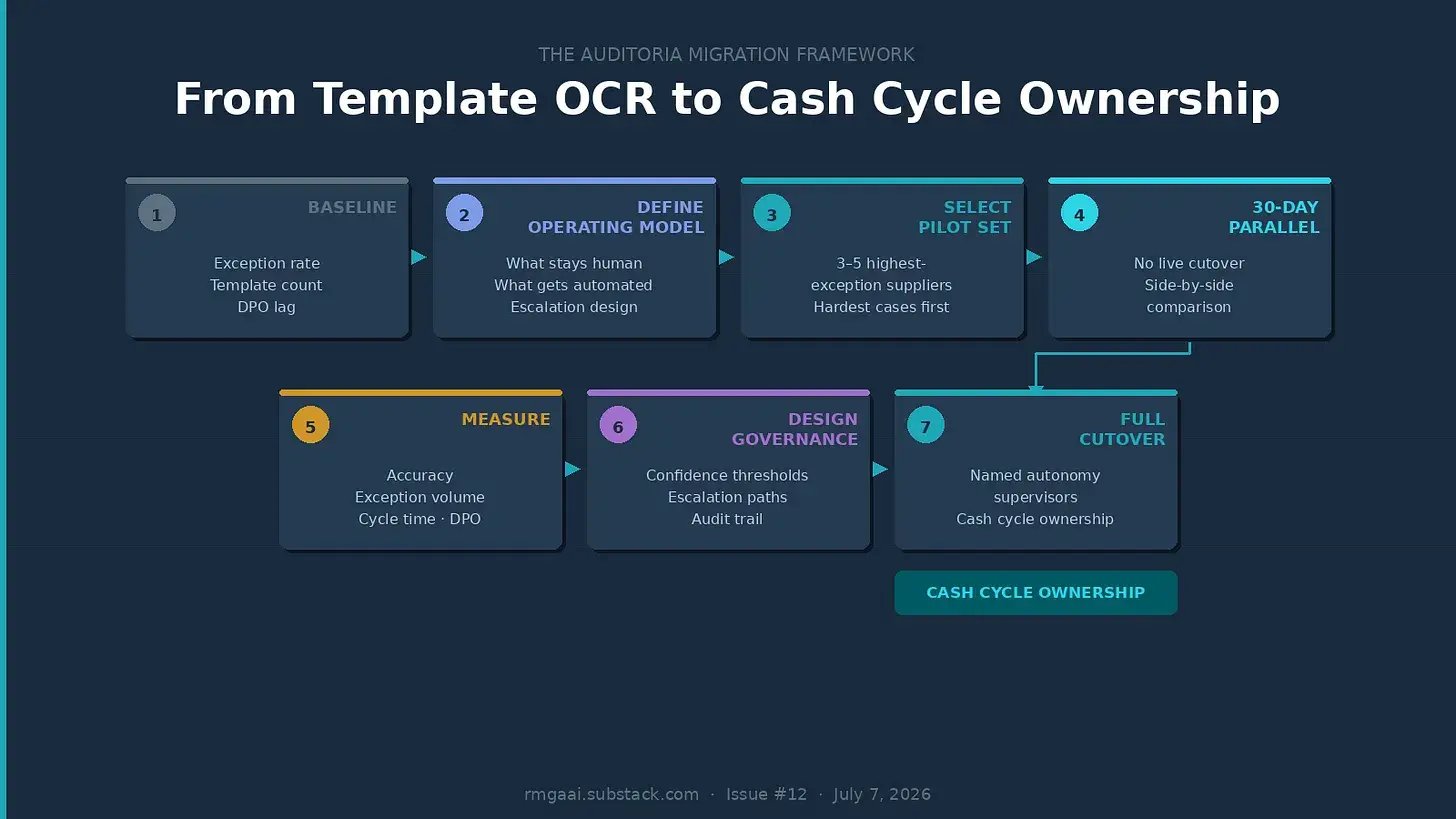
The seven-step migration framework
STEP 1
Baseline your current state
Exception rate, template count, manual touches per invoice, DPO visibility lag. These numbers set the before-picture and make outcome measurement factual.
STEP 2
Define the target operating model
Which decisions stay human? Which get automated? Which escalate with context attached? This design happens before software selection, not after.
STEP 3
Select a pilot supplier set
Three to five of your highest-exception suppliers. The hardest cases first. If they work in parallel, the rest of the portfolio is easier.
STEP 4
Run a 30-day parallel
Agentic extraction runs alongside your existing process on the pilot set. You review both outputs. You are not switching live — you are gathering evidence.
STEP 5
Measure
Extraction accuracy, exception volume, cycle time, DPO visibility improvement, template maintenance hours eliminated. Numbers that make the internal case factual.
STEP 6
Design the governance layer
Escalation paths, confidence thresholds, audit trail requirements, controller sign-off criteria. The system is deliberately conservative: auto-approved when the evidence fully supports it. If one invoice fails, the rest of the batch completes normally.
STEP 7
Full cutover with named autonomy supervisors
Existing AP reviewers whose scope narrows from routine processing to reviewing the exceptions that actually require judgment — with full document context already attached when the case arrives.
What it looks like in practice
HEALTHCARE MIGRATION
A leading healthcare system had run Lawson ERP for more than a decade before transitioning to Workday. Rather than carry their Hyland infrastructure into the new environment, they used the ERP migration as the moment to rethink the AP operating model entirely. The question was not "can we replicate what Hyland did?" It was: "what should autonomous invoice processing look like in a Workday environment, with our compliance requirements and our supplier base?" The pilot build out ran during the ERP transition window. Governance design preceded cutover. The result was a new operating model — not a legacy system transplanted into modern infrastructure.
GLOBAL CONSUMER BRAND MIGRATION
A leading global publicly traded consumer brand faced a different version of the same problem. Operating across multiple geographies with invoice formats in dozens of layouts and multiple currencies, their Hyland deployment had accumulated significant template debt — years of supplier-specific code requiring maintenance every time a format changed or a new international supplier was onboarded. The migration eliminated that model entirely. New suppliers: no IT ticket. Format variations: no code deployment. A global invoice volume that previously required per-region template management now runs on a single autonomous infrastructure with consistent governance across all geographies.
In both cases, the migration was not the hard part. The operating model design was. Once the new model was defined, the technology implementation followed it.
What's on the other side
The destination of this migration is not a lower exception rate, though that follows. It's not reduced template maintenance cost, though that follows too. The destination is ownership of the Money Out leg of your cash cycle.

- Visibility — Every invoice in flight, in real time — not summarized at close.
- Control — Payment timing enforced against policy — not approximated by queue.
- Predictability — Invoice-level data as byproduct of operation — not a reporting exercise.
- Accountability — A named owner of the exception layer — not routine processing.
That is what cash cycle ownership of the Money Out leg looks like. Not a technology improvement. An operating model with a name and an owner. The template era had a different destination: better extraction. The agentic era has a different destination: owned cash position.
Rohit Gupta is the CEO and co-founder of Auditoria.AI. Auditoria builds agentic AI for the Office of the CFO — autonomous AP, AR, and cash cycle intelligence for enterprise finance teams.