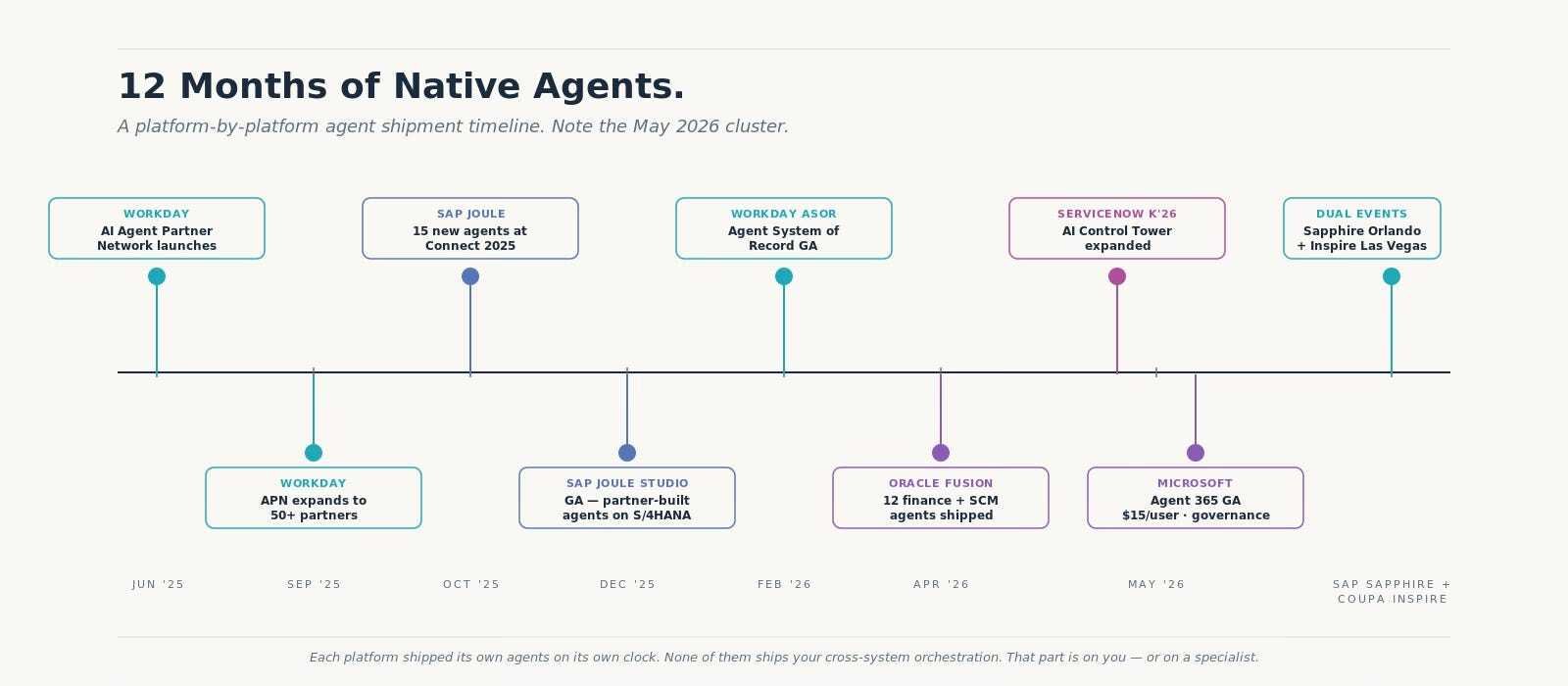
Recently, the five biggest enterprise software events converged: SAP Sapphire, Coupa Inspire, ServiceNow Knowledge 2026, Google Cloud Next '26, and Microsoft's Agent 365 general availability. Every platform vendor delivered some version of the same message: the platform you already pay for is going to ship the agents you need.
That pitch is half right. The half it misses is the half that matters.
Enterprises don't run one platform. They run a constellation.
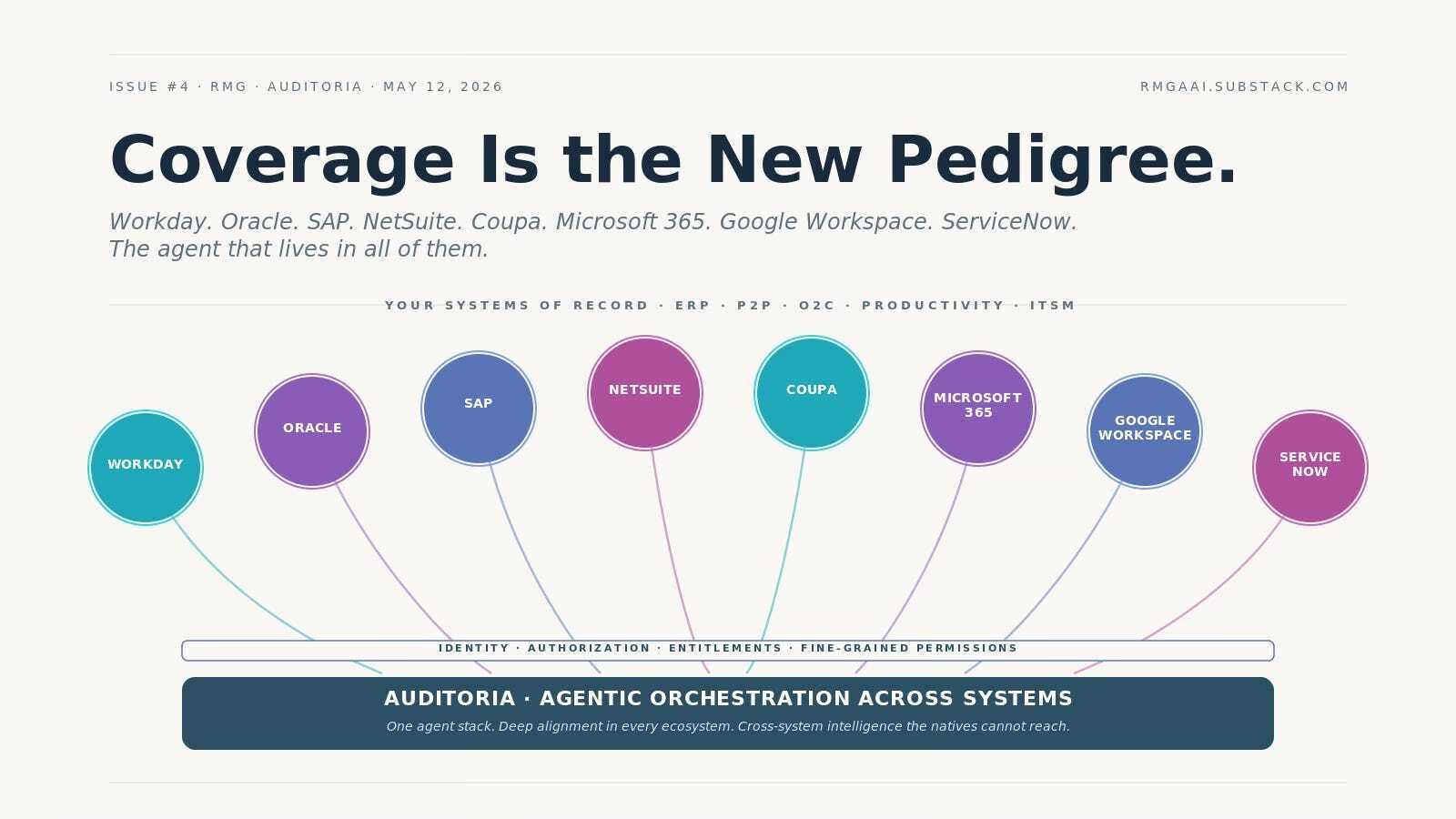
Walk through any large enterprise's actual operating reality: Workday for HCM. Oracle Fusion or EBS at the legacy core. SAP S/4HANA in manufacturing. NetSuite for international subsidiaries. Coupa for indirect spend. Microsoft 365 in one business unit, Google Workspace in another. ServiceNow, when integration breaks.
Consolidating onto a single platform takes seven to ten years with no guarantee of success. The CFO operating in 2026 doesn't have that timeline.
This is why coverage is the new pedigree. A specialized agent that runs only inside one ecosystem is a feature waiting to be swallowed by its host. A specialized platform whose agents run natively across Workday, Oracle, SAP, NetSuite, and Coupa, with the same audit log and identity-bound entitlements regardless of where the user sits, is a partner with leverage no native agent can match.
What "lives in every system" actually means
Three things have to be true at once.
1. Native interfaces, native object models. No screen-scraping. No RPA. The agent connects through each platform's published APIs, event streams, and MCP servers, reading and writing against each platform's actual object model. The vendor master in SAP is not the supplier record in NetSuite, and the agent has to understand both natively.
2. A consistent experience, system to system. The Workday user and the SAP user shouldn't have to learn two different agents. Behavior, override surface, and explainability traces should look identical regardless of where the user is logged in.
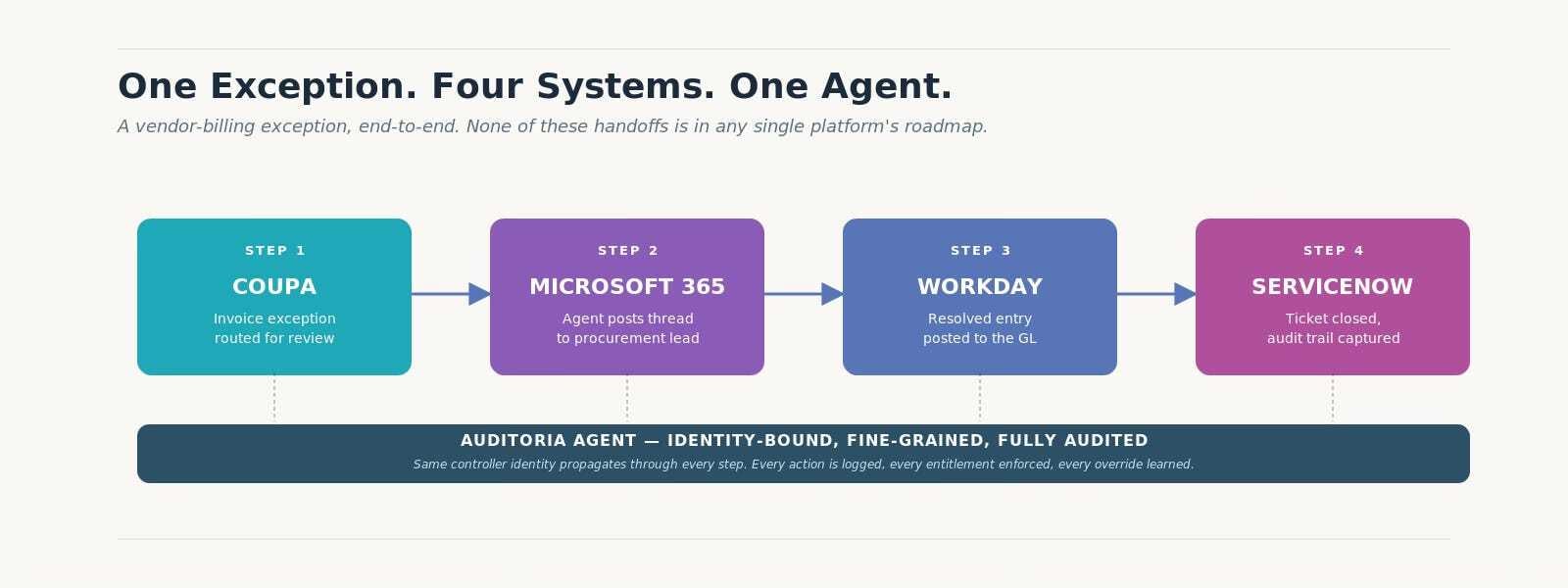
3. Orchestration across systems, not just within them. A vendor exception that begins in Coupa, resolves through Microsoft 365, posts to the Workday GL, and closes a ServiceNow ticket in one coherent flow is what enterprise finance work actually looks like. A native agent in any one of those systems can only see its own ledger.
Identity is the foundation, not a feature
If you're going to let agents work across multiple systems, you have to know exactly who's behind every action they take. Skip that, and you're heading for a compliance problem.
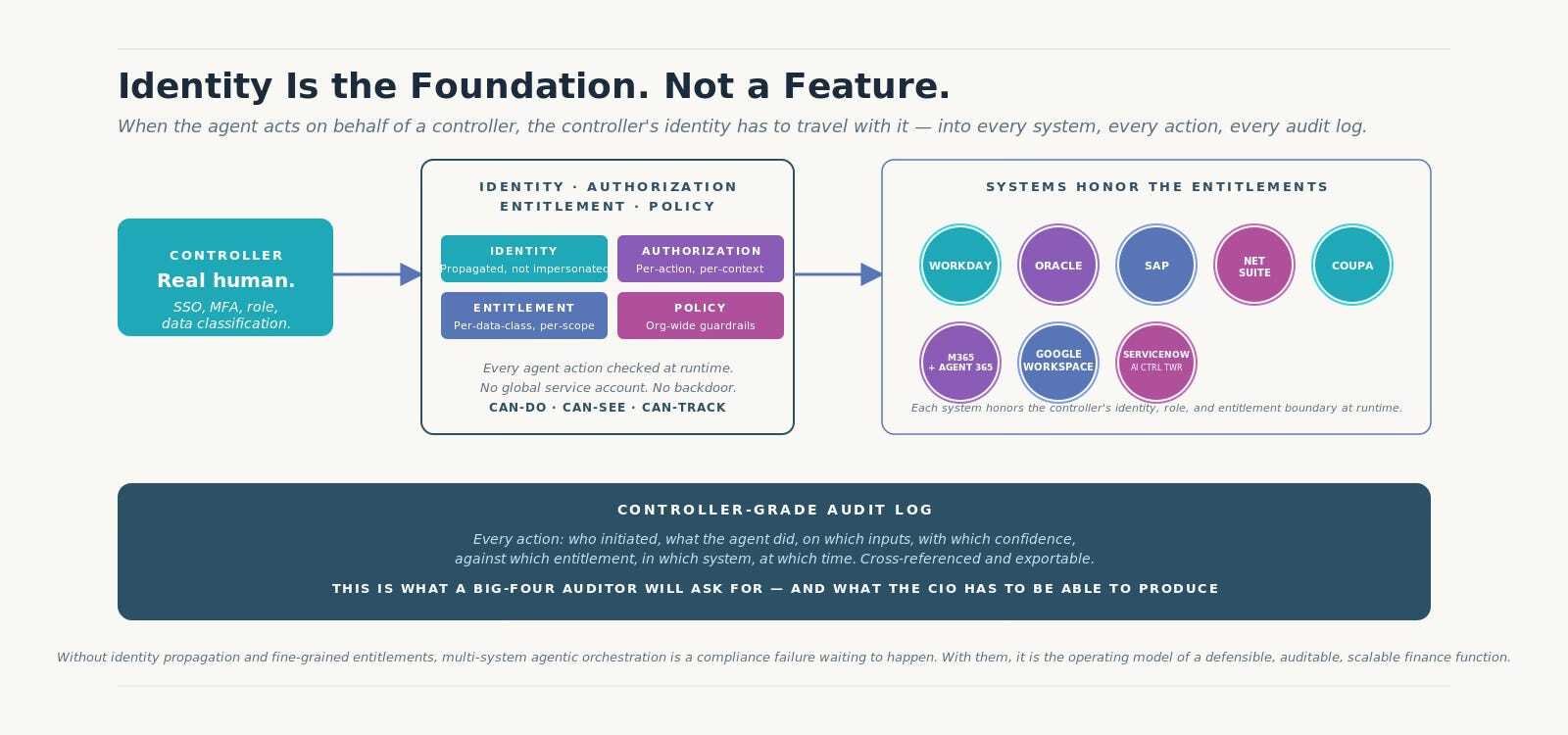
When an agent does something on behalf of a controller, it should act as that person, and not through a generic service account, or through an impersonation token that your CISO will (rightly) shut down. The controller's real identity needs to travel with the agent into every system, carried through SSO and tied to their role, the data they're allowed to see, and what they're permitted to do at each step.
Every action the agent takes should be written to an audit log a controller would trust: who did what, to which data, in which system, and when — pullable by a CIO whenever they ask. Can-do, can-see, can-track is the minimum bar.
Three reasons multi-system enterprises need a specialist
The exceptions you care about span systems. A vendor billing your SAP manufacturing arm late while your NetSuite subsidiary pays that same vendor on time, with the procurement thread in Microsoft 365 and a contract dispute in ServiceNow, is exactly the working-capital signal a CFO needs. No single-platform agent can construct it.
Different mandates produce different results. A platform vendor's roadmap covers HCM, planning, procurement, expense, and payroll. The finance specialist has one mandate: make finance agents better across every platform the customer runs.
Cross-system intelligence compounds. First-party finance data plus cross-system signal is the architecture that gets smarter over time. Native agents are walled inside their own platform. They cannot build this.
Auditoria sits across and within the finance stack
Multi-system orchestration is the goal of the Auditoria AI platform. We continue to build across and within systems of record, operations, and governance for the enterprise Office of the CFO. Some of our examples of interoperability include:
- Workday. Founding member of the Workday AI Agent Partner Network. SmartVendor and SmartCustomer are live on Workday Marketplace.
- Oracle. SmartVendor, SmartCustomer, and SmartResearch are available on Oracle Cloud, integrated with both Oracle Fusion Cloud ERP and Oracle E-Business Suite.
- SAP. In production on S/4HANA at multiple enterprise customers today, including a leading 3PL logistics provider and one of the world's foremost cybersecurity companies.
- NetSuite. Built for NetSuite certified, five years running. Multiple customers running agents for both AP and AR.
- Coupa. SmartVendor AP Invoices is a certified app on the Coupa App Marketplace.
- Microsoft 365. Agents operate in Outlook and Teams, with identity propagated via Entra and entitlements respected via Microsoft Graph and Purview.
- Google Workspace. Native interoperability with Gmail and Drive, with Workspace API integration.
- ServiceNow. Agents open, update, and close ServiceNow tickets as part of the orchestration. AI Control Tower integration forthcoming.
Three questions to ask every platform vendor
- How does your agent act on data that lives in the system next door?
Listen carefully. It is usually a roadmap slide. - How does identity propagate from our SSO through your agent into every system it touches, and how does our CIO produce a unified audit trail across all of them?
- Which specialist partner has production deployments today running the same agent stack, with the same identity controls, across Workday, Oracle, SAP, NetSuite, and Coupa?
Not sure whether a native agent covers your stack or if you need a specialized solution? Download Auditoria's AI Evaluation Guide, for Multi-System Coverage and Governance Framework, to get the scorecard CFOs and CIOs are using to make that call.
Or to discuss your multi-system agent strategy, contact us at hello@auditoria.ai.
People often ask…
What is multi-system orchestration?
Multi-system orchestration is when a single agent (or agent platform) carries a process across more than one business application. For example, picking up a vendor exception in Coupa, resolving it through emails in Microsoft 365, posting the result to the Workday general ledger, and closing the ticket in ServiceNow. Instead of four disconnected tools doing four pieces of the job, one coordinated workflow runs end-to-end across all the systems involved, with a single audit trail.
What is a specialized agent?
A specialized agent is an AI agent built to do one job — or a family of jobs — extremely well, rather than a general-purpose assistant that tries to do everything. In finance, a specialized agent focuses on tasks such as vendor management, collections, or invoice processing. Because its mandate is narrow, it can go deeper into the domain, integrate across whichever ERPs and tools the customer actually runs, and improve faster than a generalist agent bundled into a broader platform.
What is a governance framework?
A governance framework is the set of rules and controls that decide what an agent is allowed to do, on whose behalf, with which data, and how that activity is recorded. For enterprise AI agents, a strong framework covers three things: identity (the agent acts as a known user, not a shared account), entitlements (the agent can only touch data and take actions that the user is authorized for), and auditability (every action is logged in a way a CIO, CFO, or auditor can review on demand).