
Most finance teams track days payable outstanding religiously. Most track days sales outstanding carefully. Almost none track them together, with the same discipline, as a single number. And that single number is where the cash actually is.
The reason it goes untracked is not analytical. It’s organizational. AP owns DPO. AR owns DSO. And nobody owns the spread between them. So the two most important working-capital levers a finance team has get optimized in separate rooms, reported on separate dashboards, and celebrated as separate wins, even when they net to a loss.
The number nobody owns
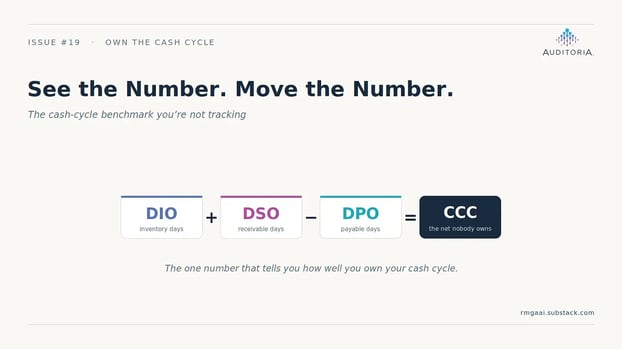
The cash conversion cycle is the number. In plain terms, it’s how many days a dollar is tied up in the business before it comes back as cash: days of inventory, plus days of receivables, minus days of payables. For an inventory business that’s DIO plus DSO minus DPO. For a services business, where inventory is negligible, it’s essentially DSO minus DPO. Lower is better. It is the single cleanest measure of how well a finance organization owns its own cash cycle.
Here’s why tracking it as one number matters, and it’s easy to miss. Imagine a team that improves DPO by five days over a quarter by renegotiating vendor terms. A clear win, and the AP dashboard shows it. In the same quarter, DSO quietly deteriorates by seven days because collections slipped. The AR dashboard shows that too, in a different meeting, framed as a temporary blip. Two departments, two reports, one of them even looks like a success. The net is minus two days of working capital. The company got worse at converting cash and nobody’s dashboard said so, because no dashboard was watching the net.
That’s the structural blind spot. When you measure the legs separately, the legs move independently, and the number that actually determines your liquidity falls through the gap between two org charts.