
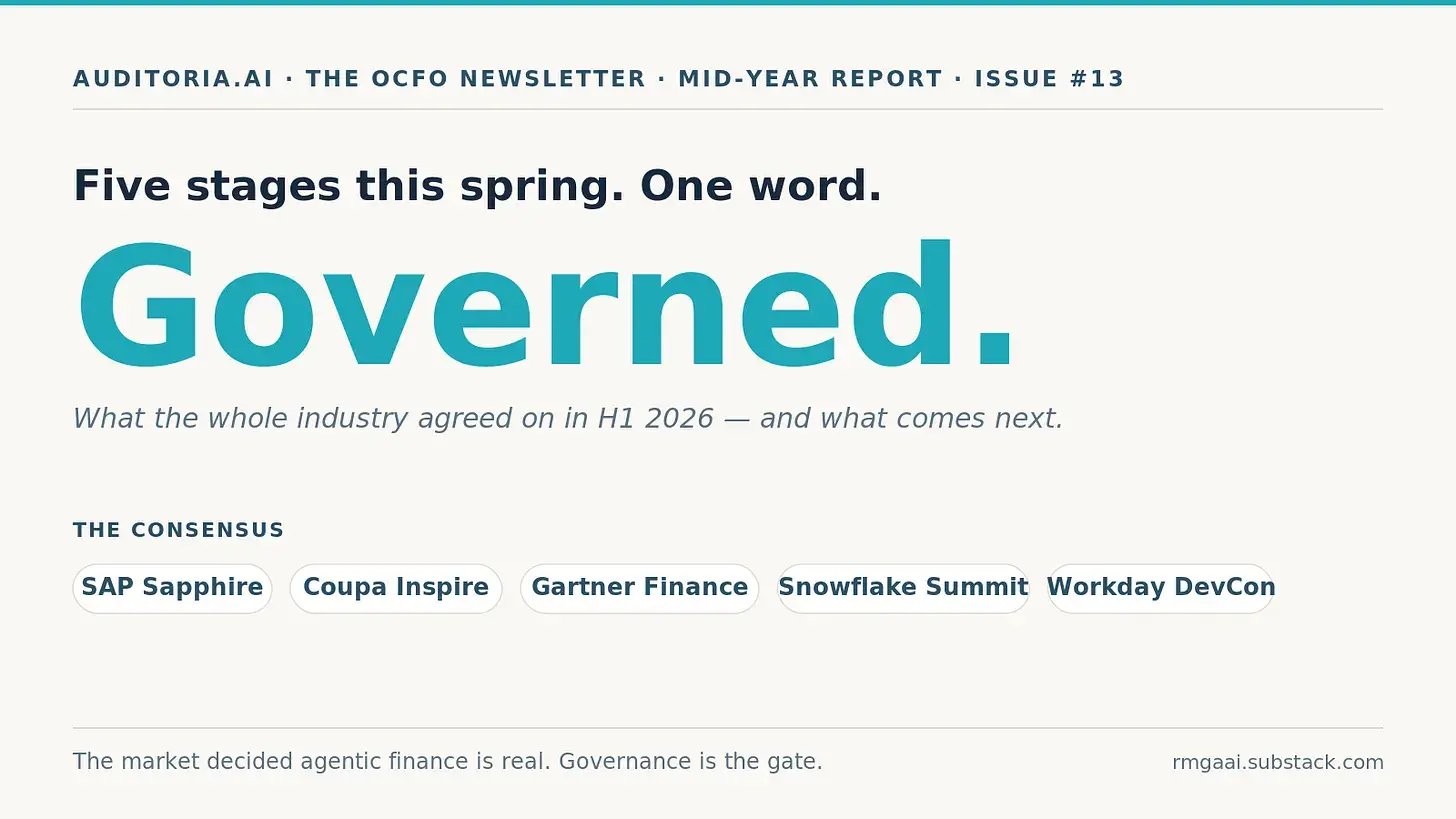
 The remarkable thing about this spring wasn’t any single announcement. It was that five competitors independently arrived at the same thesis.
SAP Sapphire (Orlando, May 11–13) unveiled what SAP calls the Autonomous Enterprise — 50-plus Joule assistants orchestrating 200-plus specialized agents on a single governed data foundation, the Business Data Cloud and Knowledge Graph. The finance headline was the Autonomous Close Assistant, built to compress the financial close from weeks to days. The premise underneath it: agents are only as trustworthy as the governed data they stand on.
Coupa Inspire (Las Vegas, May 11-14) launched Coupa Compose, an “agentic-as-a-service” layer for building and orchestrating a digital workforce across procurement, finance, and supply chain — with orchestration and control sold as the point, not an afterthought.
The Gartner Finance Symposium (National Harbor, May 27–29) said the quiet part out loud. Gartner’s message to CFOs wasn’t “adopt AI.” It was that finance leaders now own the governance of autonomous processes — that defining the decision rights between humans and machines is becoming a core CFO responsibility. Gartner also put a number on the prize: embedded AI in cloud ERP will drive a 30% faster financial close by 2028.
Snowflake Summit (San Francisco, June 1-4) framed its entire Anthropic partnership around the phrase “governed AI”; moving reasoning to where governed data already lives, via Cortex Agents that act on data without moving it out of the customer’s control.
Workday DevCon (June 1-4) may have been the most concrete of all. Workday shipped Agent Passport, a way to test, verify, and continuously monitor every AI agent against public standards like the NIST AI Risk Management Framework and an Agent System of Record (ASOR) to register and govern agents at scale. Auditoria was named a launch partner in Workday’s Agent Partner Network, alongside Accenture, AWS, Deloitte, Google Cloud, IBM, KPMG, Microsoft, and PwC.